We awoke one morning in our "gnome home" and saw through the porthole window in our front door a clear sign of the changing seasons.
The air temperature in central Maine has dropped and we could feel it in the lodge. Warming by the stove and eating oatmeal for breakfast became part of our comfort routine.
For our kids, the snow inspired snowballs, snow forts, and boot skating with their friends.
For the adults, it was time to make sure we had everything prepared for winter. The root cellar has been stocked with crates of apples, sacks of root vegetables, shelves of cabbages, and jars of sauerkraut.
It's also time to transplant kale from the garden into the greenhouse alongside the less hearty greens Shelly and the other apprentices transplanted weeks ago.
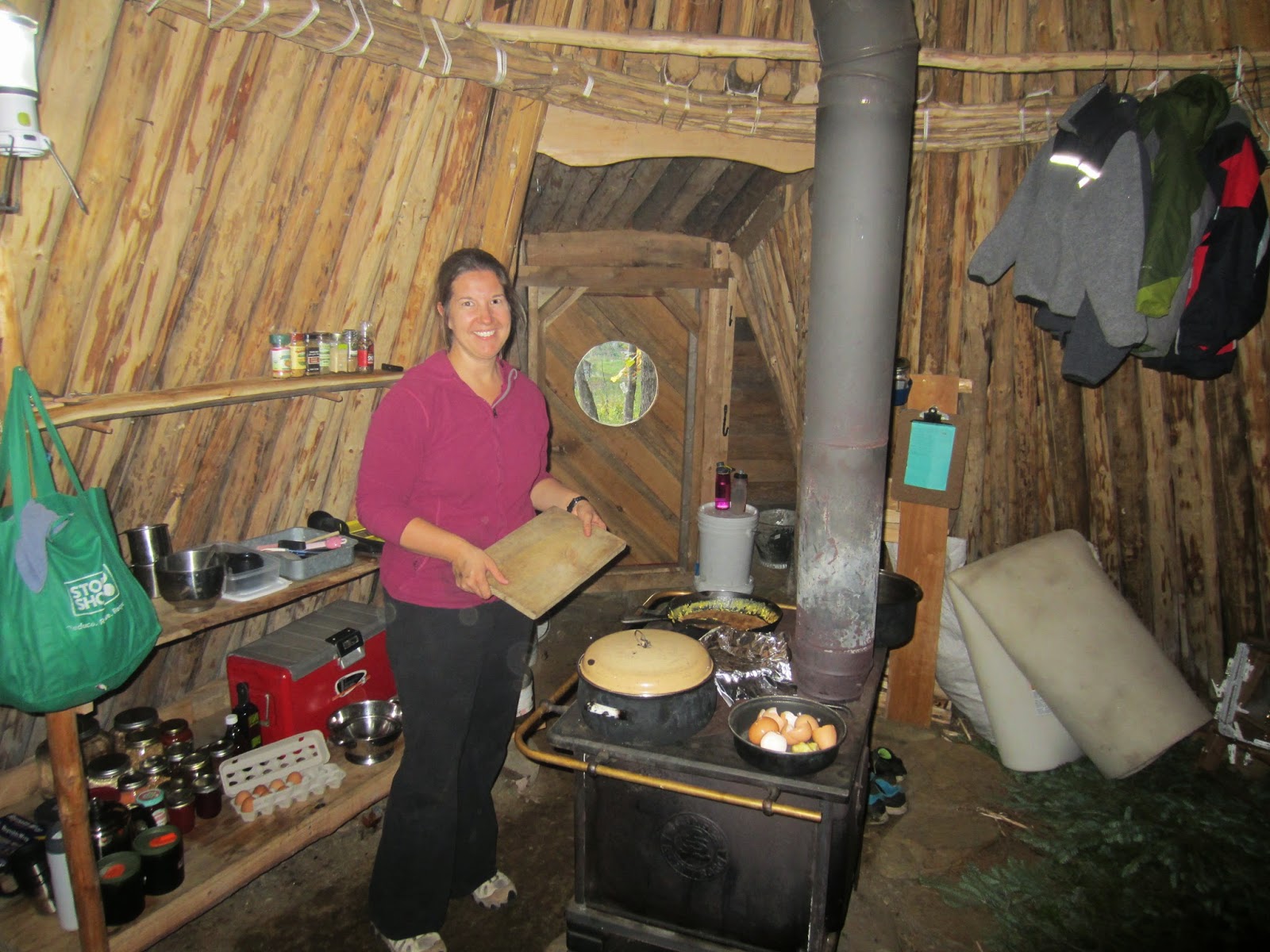
Cooler temps also meant that Shelly's baking not only filled our bellies but warmed the lodge. She's mastered bread baking in a cast iron skillet and has continued to experiment with things like acorn-flour biscuits.
Shelly baked some biscuits and squash for a game night in the lodge with the other apprentices. It was a fun way to enjoy one of our last evenings with these three great people in our community.
Indeed we'll miss the community that we've enjoyed for two months. There is strong character in the hearty people that live and work here.
But even as we say goodbye to the people of Koviashuvik, there will be some things that live on with us. The songs we sing at meals. The skills we learned living off the grid. The inner strength we each find when we're stretched out of our comfort zone.
But again, most of all, we take with us the confidence that our family can do anything. Together.
Sunday, November 23, 2014
Sunday, November 16, 2014
Just Having Fun
Yes, we chop wood every day and go to the bathroom in a bucket out back. But not everything we do is a chore. There's some fun we have in our small community too--especially for the kids.
Our boys have had fun playing with the other kids that live here.
And sometimes the fun is with the animals: chasing ducks, petting the cat, or holding the black bunny.
When we leave the kids to their own devices, often they get creative.
Certainly our environment encourages being crafty.
And sometimes the line between chore and fun gets blurry. Helping with raking and harvesting and nail-pounding and fire-starting and cooking and wood-splitting can be fun in and of itself too.
We have one more week in our apprenticeship and then like most of you we'll pause to reflect on all we have to be thankful for. Family fun will certainly be on this year's long list.
Our boys have had fun playing with the other kids that live here.
| The boys enjoy a Bonnie Bee sandwich. |
![]() |
| Snacks and chess and friends. Excellent. |
| Tumbling on a tarp full of leaves. |
| Hannah is a tolerant bunny! |
| Baxter devised a way to stand-up paddleboard on the pond. . . . |
![]() |
| Atticus concentrates on carving a wooden leaf. |
![]() |
| Baxter chooses a leaf wreath instead. |
| Atticus starts making a cedar spoon by burning out the deep cavity with a coal from our wood stove. |
| Boys help make applesauce from foraged apples. |
Saturday, November 8, 2014
Tools of the Trade
Our teachers at the local living school where we are apprenticing consider things from the natural world as gifts. Water from the spring is a gift. The sun that warms the greenhouse is a gift.
The things we get from trees are also gifts: the acorn we wrote about in our last post; the leaves that give back their minerals as they decay; the sap of the maple that becomes syrup; the basswood bark that becomes string, the growth rings of the ash that become baskets; the timber that becomes shelter; the firewood that warms our food and our bodies.
I have a personal affection for the tree gifts. I've participated in harvesting all the above gifts from the tree and am most fond of the wood gifts that are used for building and warming. Using time-honored techniques, I am learning how to construct buildings, make furniture, and create firewood with a small quiver of tools.
Every day, we use a decent amount of wood from our stash and need to replenish it.
Though chainsaws are sometimes used here at Koviashuvik, there's a preference for using bow saws to cut fire wood to length.
We'll split these logs once or twice and let them dry for use by future apprentices to use just as we pull from the pile that was split and stacked many months ago by others. Every morning we use a lovely, hand-crafted splitting maul to split them into thinner slices that burn great in our stove.
It's true what's said about wood heating you twice!
When woodworking, we use a different set of tools.
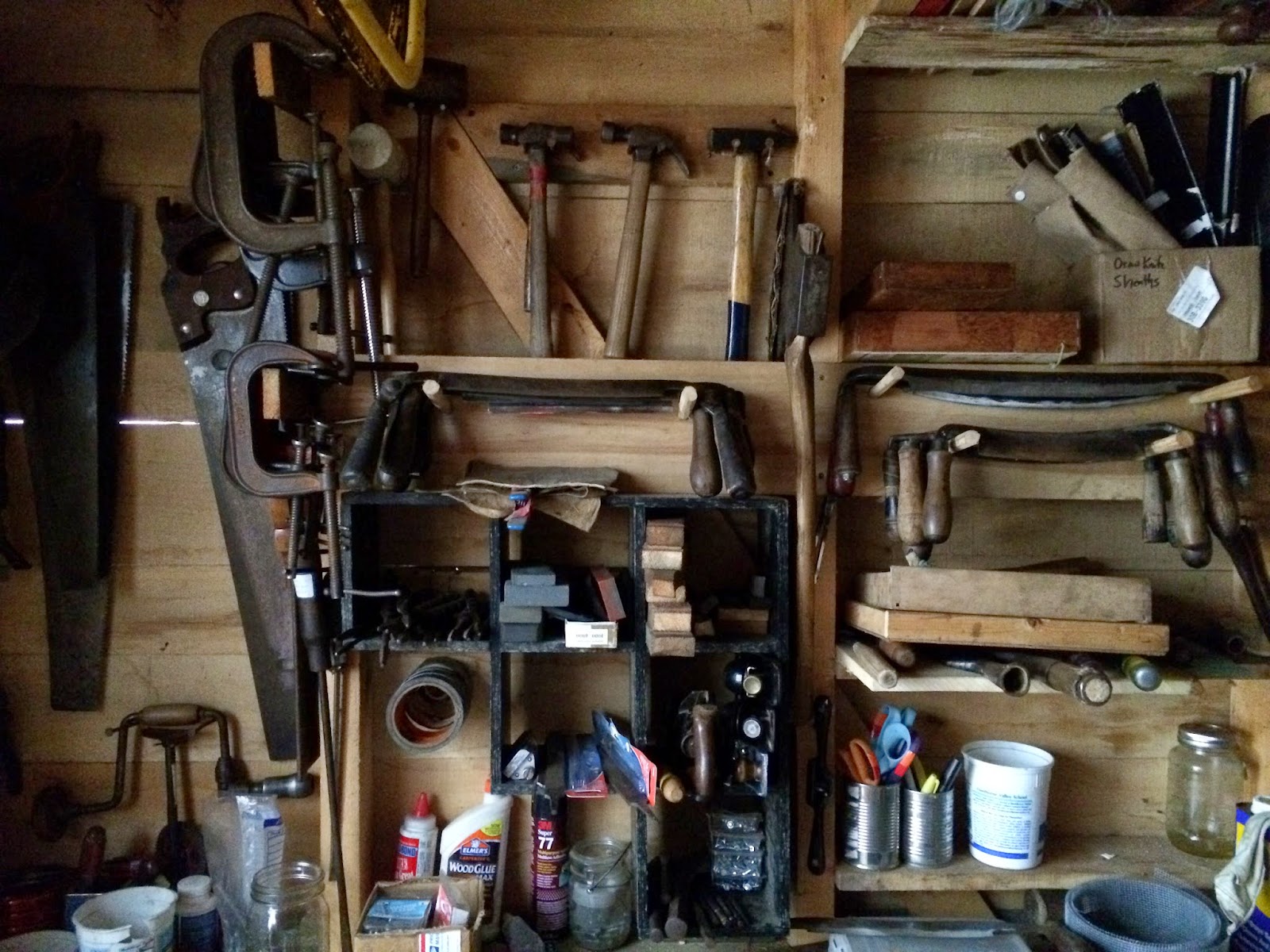
Perhaps second only to the handsaw in usefulness is the drawknife.
It's the tool that stripped the hundreds of fir poles used in various construction projects here at Koviashuvik. It's also the tool I used to strip, shape, and size four legs out of hornbeam wood for a bench I've been making. Here's one of those legs clamped into the shave horse bench, a partner to the draw knife:
On bigger building projects, we've used additional tools to turn trees into shelter. After being cut down, trees that are going to become lumber are cut with a portable saw mill and then "stickered" in stacks for air drying for a year. From there, the rough lumber is often run through a gas-powered planer for smoothing or shaping. We cut the pieces to length with handsaws. Last week I was cutting compound miter cuts in boards for roof sheathing freehand with a handsaw.
Thereafter, I found myself tapering boards into shims only 1/4 inch thick using an axe visually similar to our splitting maul but very different in its utility.
In addition to mortise and tenon construction in the framing of the new classroom building, we nail and screw things together. Fasteners are one of the biggest expenses in the whole building process here. When fine tuning fits and finishes we use tools like block planes and--like I'm using in this picture on the bunk room roof--spoke shaves to get things just how we want.
On my personal goals list was learning about constructing with wood and hand tools. I've recently gotten an abundance and am thankful for the gift from the tree.
The things we get from trees are also gifts: the acorn we wrote about in our last post; the leaves that give back their minerals as they decay; the sap of the maple that becomes syrup; the basswood bark that becomes string, the growth rings of the ash that become baskets; the timber that becomes shelter; the firewood that warms our food and our bodies.
I have a personal affection for the tree gifts. I've participated in harvesting all the above gifts from the tree and am most fond of the wood gifts that are used for building and warming. Using time-honored techniques, I am learning how to construct buildings, make furniture, and create firewood with a small quiver of tools.
Every day, we use a decent amount of wood from our stash and need to replenish it.
Though chainsaws are sometimes used here at Koviashuvik, there's a preference for using bow saws to cut fire wood to length.
We'll split these logs once or twice and let them dry for use by future apprentices to use just as we pull from the pile that was split and stacked many months ago by others. Every morning we use a lovely, hand-crafted splitting maul to split them into thinner slices that burn great in our stove.
It's true what's said about wood heating you twice!
When woodworking, we use a different set of tools.
Perhaps second only to the handsaw in usefulness is the drawknife.
It's the tool that stripped the hundreds of fir poles used in various construction projects here at Koviashuvik. It's also the tool I used to strip, shape, and size four legs out of hornbeam wood for a bench I've been making. Here's one of those legs clamped into the shave horse bench, a partner to the draw knife:
On bigger building projects, we've used additional tools to turn trees into shelter. After being cut down, trees that are going to become lumber are cut with a portable saw mill and then "stickered" in stacks for air drying for a year. From there, the rough lumber is often run through a gas-powered planer for smoothing or shaping. We cut the pieces to length with handsaws. Last week I was cutting compound miter cuts in boards for roof sheathing freehand with a handsaw.
Thereafter, I found myself tapering boards into shims only 1/4 inch thick using an axe visually similar to our splitting maul but very different in its utility.
In addition to mortise and tenon construction in the framing of the new classroom building, we nail and screw things together. Fasteners are one of the biggest expenses in the whole building process here. When fine tuning fits and finishes we use tools like block planes and--like I'm using in this picture on the bunk room roof--spoke shaves to get things just how we want.
On my personal goals list was learning about constructing with wood and hand tools. I've recently gotten an abundance and am thankful for the gift from the tree.
Friday, October 24, 2014
Foraging for Food
You’ve seen our unique living quarters and the beautiful property we’re inhabiting during our two-month stint at Koviashuvik Local Living School. But what do we do here?
Monday through Friday our family greets the morning with the other residents here and discusses the tasks for the day. Usually our teacher Chris guides us through a bit of weather forecasting by reading the signs of the sky before sharing an appropriate plan. The majority of what we do is specific to the season.
On our first week here, we went for a leaf harvest. That’s right, we traveled to neighboring properties to rake up leaves and load them into a pickup truck.
By stomping the leaves down after each tarp full, we could get half a ton of leaves in the rigged truck bed before taking them back to a leaf composting pile at Koviashuvik. And then we repeated. Evidently, these leaves will be used as a soil amendment to the gardens in the Spring as they are rich in nutrients found only deep in the soil where the trees’ roots can reach.
Over the course of several other days, we foraged for and processed one of the staple foods for winter residents here: acorns.
Acorns are a rich protein and fat source that can be turned into flour through a process of drying, cracking, water-separating, leaching, grinding, and sifting.
![]() |
| Cracking. |
![]() |
| Water-separating. |
![]() |
| Sifting. |
We’ve learned here that food can be acquired for very little money provided you’re willing to invest the time into the process. Garden food fits that category too. Some foods like potatoes grow, harvest, and store relatively easily.
| Potato harvesting. |
Other foods like beans take a bit more work to grow, train, pick, thresh, winnow, and dry before they’re ready for storage.
| Picking beans. |
| Threshing in grain sacks. |
Similar to feelings we had when living with our host family in Guatemala, we’re appreciating how much goes into basic food needs. The emphasis at Koviashuvik is local. It’s hard to get much more local than the acorns falling at our feet. What a gift from the oak!
Saturday, October 18, 2014
Koviashuvik Local Living School
The "gnome home" we wrote about in our last post caught the interest of many of our readers. It is one of many components of the place we are living during October and November. Up to this point, we've referred to the property as a homestead, but more specifically it is called Koviashuvik Local Living School.
Koviashuvik is an Inuit word loosely meaning a time and place of joy. Our hosts are Chris and Ashirah Knapp who bought this rural, wooded Maine parcel years ago and have gradually transformed it into a property that supports their family of four, teaches occasional day-students, and feeds and houses apprentices throughout the year.
The Knapp family lives in a tiny home (less than 500 sq ft) they built with wood they exclusively harvested from their property.
This off-grid home has enough solar power to run a few CFL lightbulbs each evening and charge some batteries in rechargeable devices. Drinking water is carried in with a yoke from a nearby spring 10 gallons (80 lbs) at a time. Wash water is collected from what the clouds release. Heat, cooking, and clothes-drying are all courtesy of the wood stove.
Storage crops like root vegetables, cabbages, and apples chill out in the stand-alone root cellar all the way into June when the cache finally disappears.
A passive-solar greenhouse provides nutritional, fresh greens for the family during the winter months. With a rain water collection system and a solar hot-water heater installed, this is also the only spot on the property where a warm shower is possible.
Serving as an outdoor classroom and a woodworking facility, the "shed shop" and its vestibule is a hub of productive activity. It's here that fir poles are stripped for construction, axe handles are crafted, and furniture is made--all with hand tools.
To further their vision and facilitate more year-round learning, the Knapps are also constructing a classroom building. As you might suspect, the lumber for this project also has been harvested and milled exclusively on the grounds. The post and beam framing includes several hand-hewn logs.
To support the growing number of students expected when the classroom is completed next year, a "humanure" outhouse actively composts waste.
Hopefully this quick visual tour of Koviashuvik's facilities helps paint a picture of our setting. The old-world style of construction and earth-conscious design also point to more than our physical surroundings--they embody the character of the people who live and work here.
In addition to the Knapp family, we're sharing this special place with three younger apprentices.
As we've knelt in the dirt with them, shared meals with them, and learned alongside them we've found them to be impressively mature and very capable despite two of them being half our age. We're pleased to be fellow apprentices with people of such great character.
I think the magnetism of Koviashuvik attracts a special kind of mettle.
Koviashuvik is an Inuit word loosely meaning a time and place of joy. Our hosts are Chris and Ashirah Knapp who bought this rural, wooded Maine parcel years ago and have gradually transformed it into a property that supports their family of four, teaches occasional day-students, and feeds and houses apprentices throughout the year.
![]() |
| Chris teaches a home school class flanked by his children Owen (7) and Bonnie Bee (5). |
| Ashirah poses with her daughter. |
This off-grid home has enough solar power to run a few CFL lightbulbs each evening and charge some batteries in rechargeable devices. Drinking water is carried in with a yoke from a nearby spring 10 gallons (80 lbs) at a time. Wash water is collected from what the clouds release. Heat, cooking, and clothes-drying are all courtesy of the wood stove.
Storage crops like root vegetables, cabbages, and apples chill out in the stand-alone root cellar all the way into June when the cache finally disappears.
A passive-solar greenhouse provides nutritional, fresh greens for the family during the winter months. With a rain water collection system and a solar hot-water heater installed, this is also the only spot on the property where a warm shower is possible.
Serving as an outdoor classroom and a woodworking facility, the "shed shop" and its vestibule is a hub of productive activity. It's here that fir poles are stripped for construction, axe handles are crafted, and furniture is made--all with hand tools.
To further their vision and facilitate more year-round learning, the Knapps are also constructing a classroom building. As you might suspect, the lumber for this project also has been harvested and milled exclusively on the grounds. The post and beam framing includes several hand-hewn logs.
To support the growing number of students expected when the classroom is completed next year, a "humanure" outhouse actively composts waste.
Hopefully this quick visual tour of Koviashuvik's facilities helps paint a picture of our setting. The old-world style of construction and earth-conscious design also point to more than our physical surroundings--they embody the character of the people who live and work here.
In addition to the Knapp family, we're sharing this special place with three younger apprentices.
| Yard, Lottie, and Carensa enjoy a lighter moment fixing Yard's bike together in the shed shop. |
I think the magnetism of Koviashuvik attracts a special kind of mettle.
Saturday, October 11, 2014
Into the Woods
Adventure has found us again and this time it's in the woods. Chapter three of our sabbatical journey brings us to a homestead near Farmington, ME where we learn to live off the land much more than we've ever done before. Our first week at the homestead has been a period of moving in and adjusting to the new lifestyle.
Just as our tight living space in Guatemala, Ecuador, and on the road in our trailer took some getting used to, so too our adorable living quarters on the homestead come with a learning curve. We affectionately refer to this as the "gnome home."
This sod-covered stick-built structure is where we'll do our cooking, eating, and sleeping during October and November.
Half the floor of this one-room hut is exposed dirt, the other half is dirt covered with balsam fir which gives it a little spring and lovely aroma each time we enter. We cook and heat with the wood-fired stove.
Without running water, we collect rainwater for "wash water" and carry in buckets of water from a nearby spring for drinking and cooking water. Though we could sleep on the fir boughs, our family is trying out sleeping in the loft we access by a wooden ladder. The floor space is roughly that of a queen bed, but more oddly shaped.
Without electricity, our abode is always a little dim and in the evenings plain dark. We supplement with rechargeable lanterns and headlamps but we still find ourselves drawn in by our circadian rhythms. Never a family to go to bed early, sometimes we're all in bed by 8:00 if we've finished the chores for the evening.
It'll likely warrant a full blog post, but for now we'll finish the brief tour of our living space by answering what a few of you are likely asking at this point. Where is the bathroom? Well, it's an open air outhouse with a bucket.
Back to the land indeed! We look forward to sharing with you our day-to-day activities, other neat structures, living systems, and the people we work with at this beautiful place. It's a pretty time of year to be harvesting the late-season crops from the garden.
Just as our tight living space in Guatemala, Ecuador, and on the road in our trailer took some getting used to, so too our adorable living quarters on the homestead come with a learning curve. We affectionately refer to this as the "gnome home."
This sod-covered stick-built structure is where we'll do our cooking, eating, and sleeping during October and November.
Half the floor of this one-room hut is exposed dirt, the other half is dirt covered with balsam fir which gives it a little spring and lovely aroma each time we enter. We cook and heat with the wood-fired stove.
Without running water, we collect rainwater for "wash water" and carry in buckets of water from a nearby spring for drinking and cooking water. Though we could sleep on the fir boughs, our family is trying out sleeping in the loft we access by a wooden ladder. The floor space is roughly that of a queen bed, but more oddly shaped.
Without electricity, our abode is always a little dim and in the evenings plain dark. We supplement with rechargeable lanterns and headlamps but we still find ourselves drawn in by our circadian rhythms. Never a family to go to bed early, sometimes we're all in bed by 8:00 if we've finished the chores for the evening.
It'll likely warrant a full blog post, but for now we'll finish the brief tour of our living space by answering what a few of you are likely asking at this point. Where is the bathroom? Well, it's an open air outhouse with a bucket.
Back to the land indeed! We look forward to sharing with you our day-to-day activities, other neat structures, living systems, and the people we work with at this beautiful place. It's a pretty time of year to be harvesting the late-season crops from the garden.
Subscribe to:
Posts (Atom)